On the seaside promenade in Colwyn Bay is a special new piece of public art, and I wasn’t going to leave town this morning without seeing it. The new bronze statue, by sculptor Nick Elphick, is a life-size depiction of Terry Jones, of Monty Python fame, as the infamous naked organist who featured in some of their comedy sketches. It was unveiled in April 2026 by fellow Pythons Michael Palin and Terry Gilliam. And it is rather wonderful.
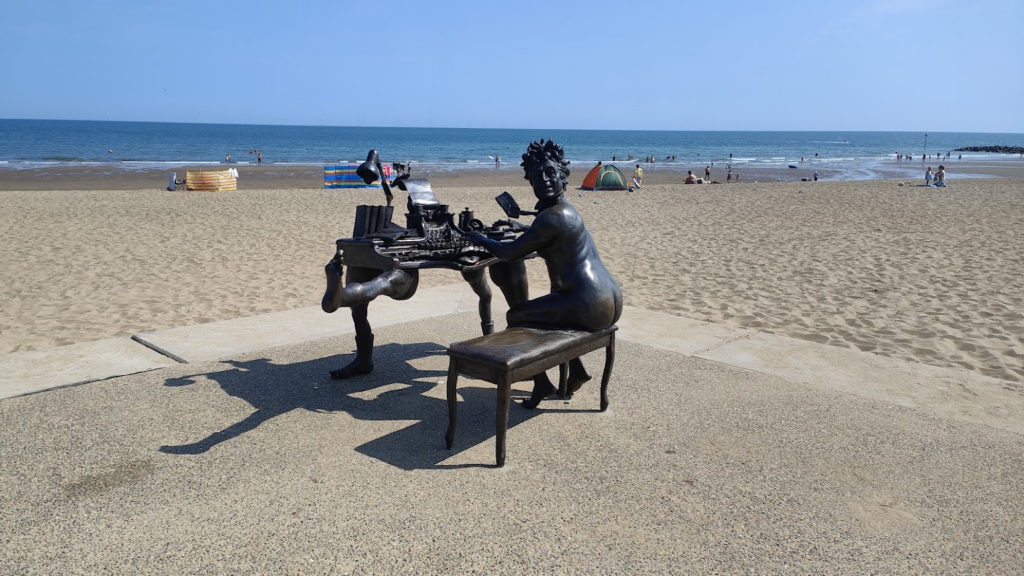
Terry was a native of Colwyn Bay, and they have honoured him appropriately. He was a multi-talented and brilliant man, known not only for his silly comedy as part of the Monty Python team and the writing partner of Michael Palin; but also for being a compelling film maker (he directed all of the Python films and more) and mediaeval historian. He died in 2020 aged 77, having spent the last 8 years of his life married to a woman (a Swedish-born knitwear designer) 41 years his junior! Sadly, much of this period of his life was blighted by dementia, and by 2016 he could no longer give interviews.
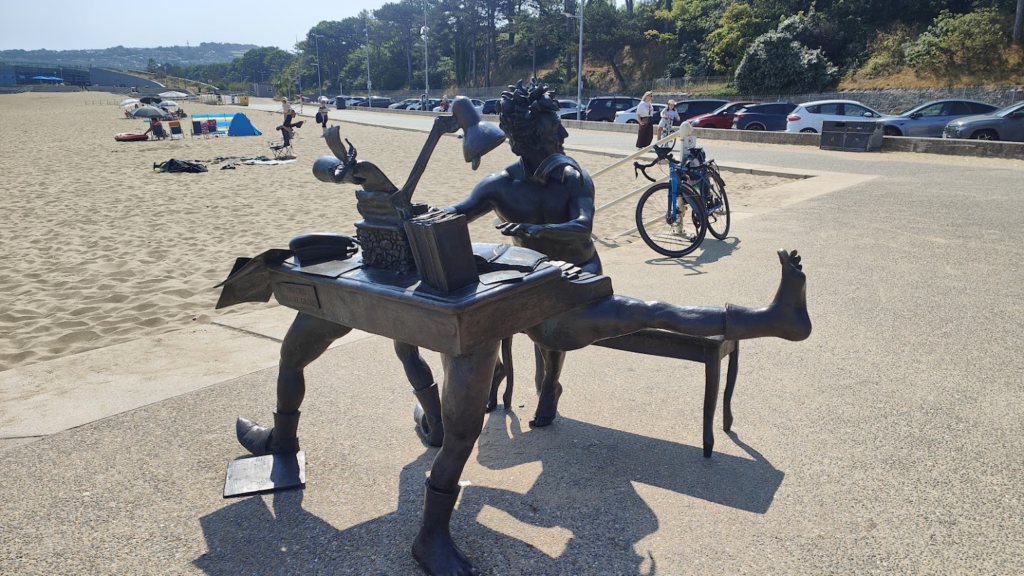
The town’s memorial to him is suitably zany and uplifting. Silliness is, in my view, an underrated characteristic. Terry Jones shared it with the world with grace and aplomb. I was told that the thing to do was touch his bare bottom, so I obliged. It will surely remain shiny long after the rest of the sculpture has tarnished in the sea air. It is fitting that a person like Terry Jones is remembered in this way and continues to bring joy to others after his death. It was a good start to my day.
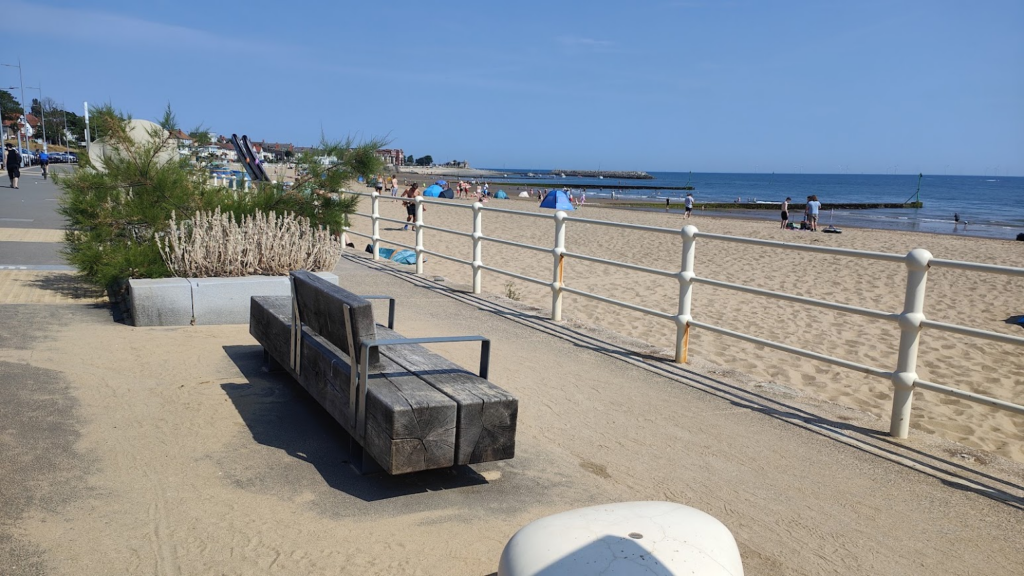
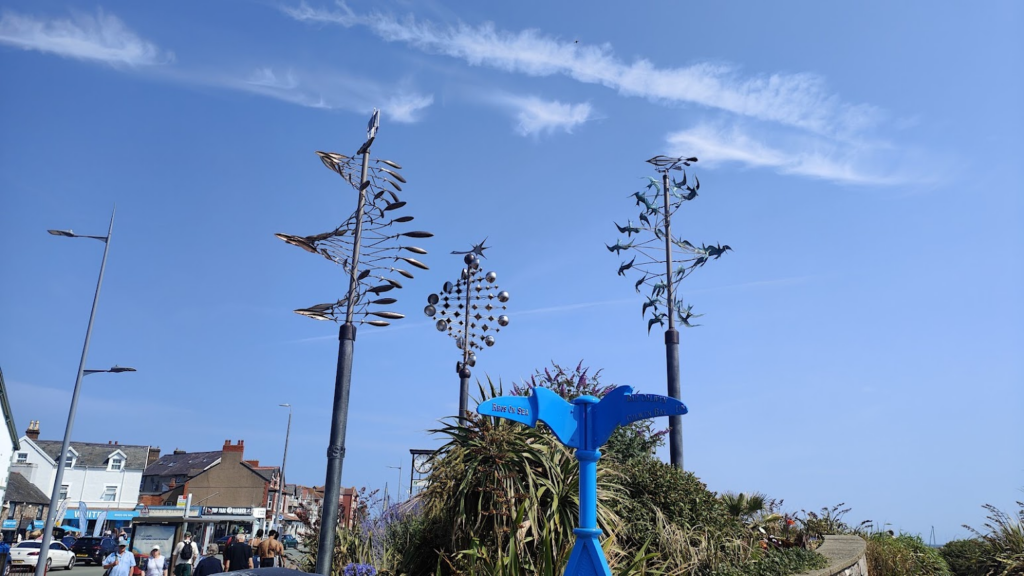
From here, I had the pleasure of cycling along the popular and cycle-friendly promenade, around the sweeping arc of the bay to Rhos-on-Sea, where my grandparents lived. All along were golden, sandy beaches. In the sunshine everywhere had a bright, optimistic feel about it. The promenade in Rhos has been given a recent facelift and there is excellent public planting, new seating and prominent art installations to enjoy. In this hot weather, I was pleased to see that the children’s paddling pool is still open for families to enjoy, as I did myself when a small child, more than fifty years ago. My little brother Dan fell in the shallow water here as a very small child and swam his first instinctive swimming strokes to stay afloat; but I remember it more as a place for toy boats and picnics sitting on towels. The lawns around it were looking yellow and parched from the recent hot weather; but otherwise it didn’t seem to have changed much at all. Public attitudes have, however; so I refrained today from taking any photos where small children were playing!
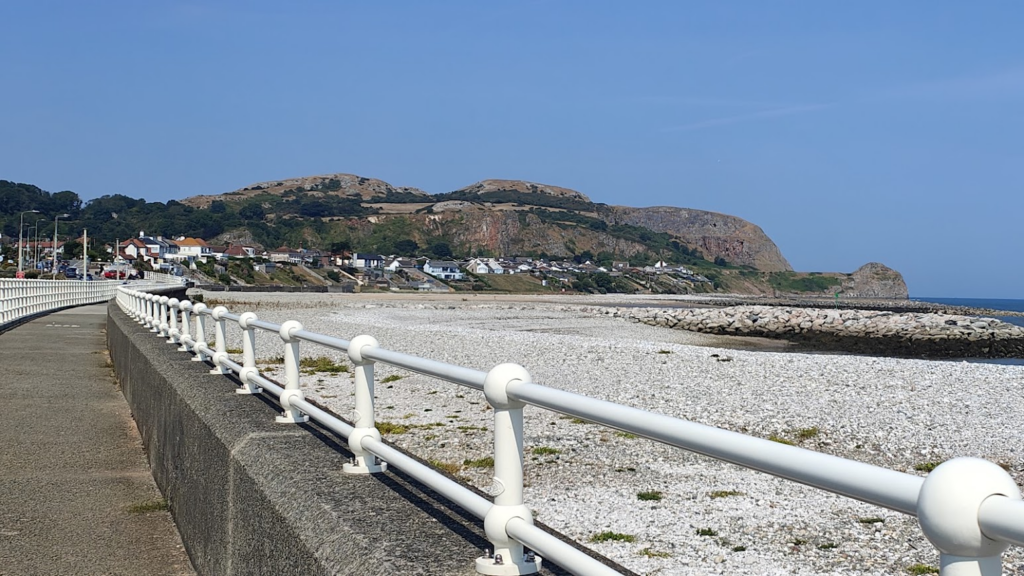
I was booked on an afternoon train home from Bangor, because – this being July 2026 – I wanted to get back in time to watch England’s next football match in the World Cup. But I had plenty of time for the moderate – if rather spectacular – 25 mile bicycle journey there along the coast, so I wasn’t in a hurry. I still feel plenty of nostalgia for this area and it mostly felt happily familiar. Continuing beyond Rhos, the distinctive headland of the Little Orme came into view. This divides Penrhyn Bay, which I now entered, from Llandudno, a couple of miles beyond on the far side; but out of sight. This was a prominent feature of the superb views my grandparents enjoyed from their bungalow up above the golf course, a mile or so inland from where I cycled. To one side they could see the sea over the rooftops of Rhos, and to the other side, some of the closer mountains of Snowdonia. The Little Orme was in between, straight ahead. Their bungalow stuck out beyond their next-door neighbours on either side, and they would have had the best views of all. I remember my grandma proudly telling us how she had chosen it from the plans, and how my grandad promised her wish would be met. She was a formidable woman and I am not sure that he would have dared argue!
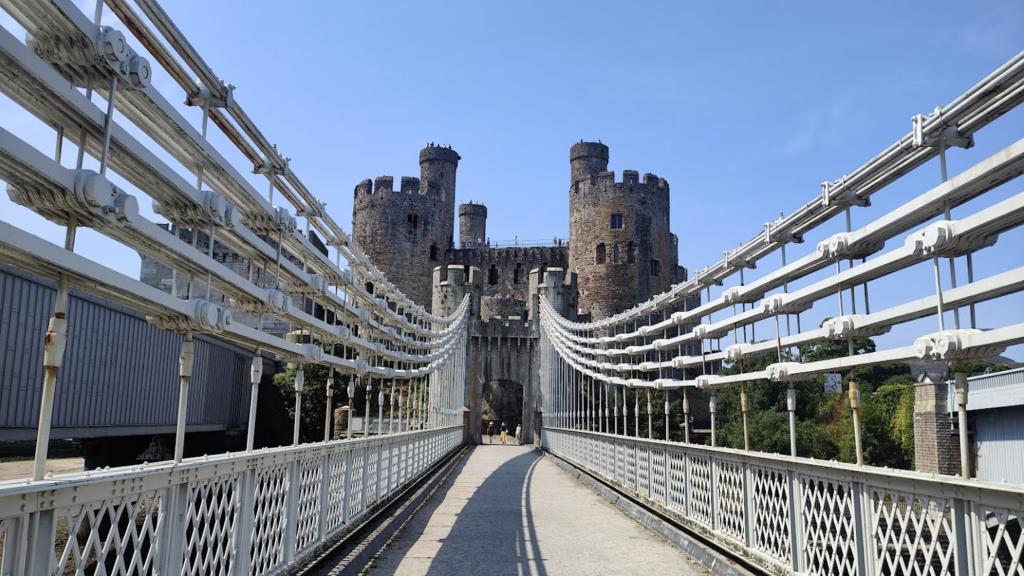
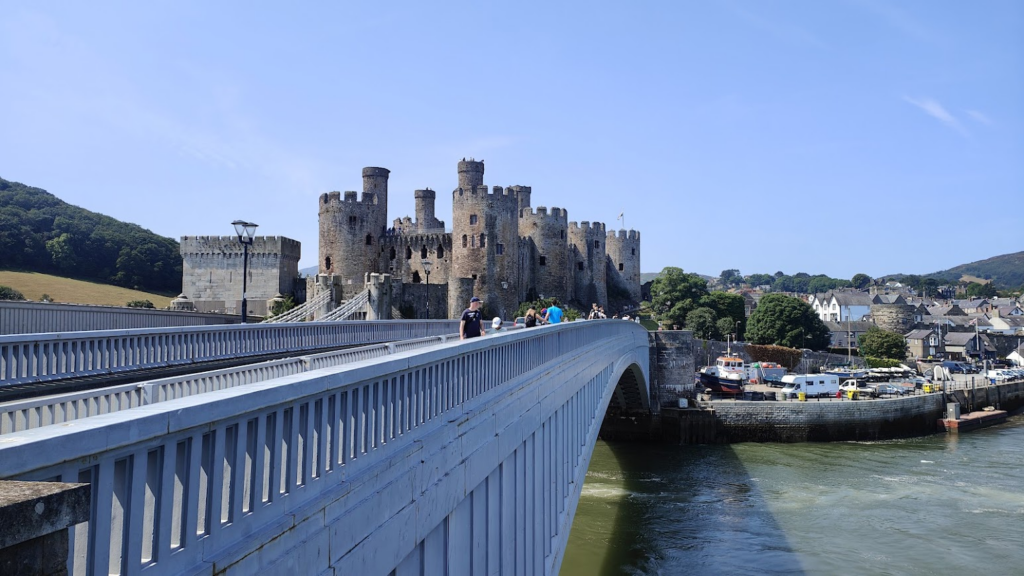
I followed some tiny lanes to Llandudno Junction, and from there crossed the bridge over the Conwy Estuary to Conwy itself, heading all the time towards the magnificent castle. This is surely one of the finest to be found anywhere, rising steeply from the water’s edge, defended at every angle with solid round stone towers and battlements. It is a proper, complete mediaeval castle and its setting only adds to the grandeur of the scene.
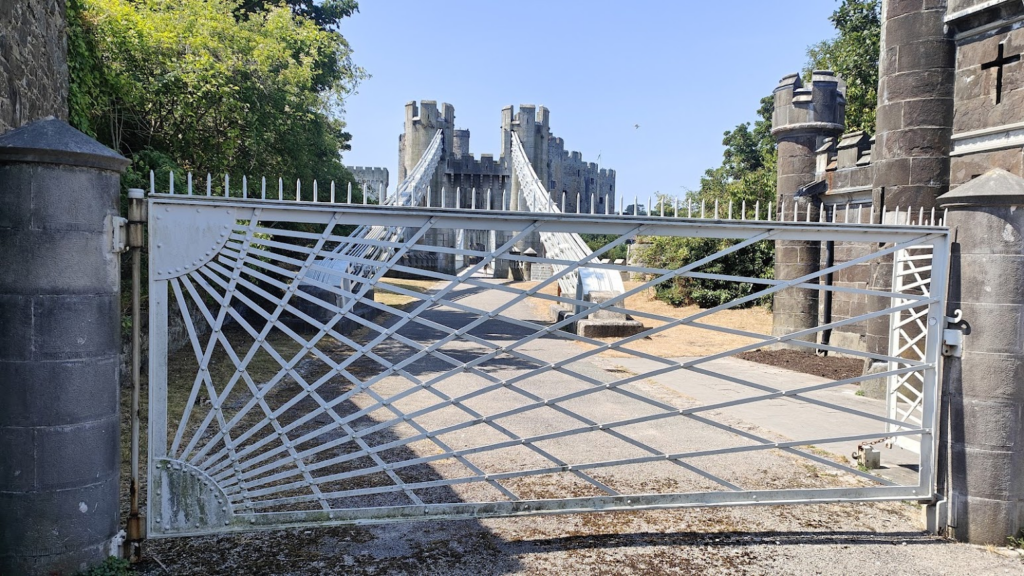
There are actually three bridges over the river at this narrow crossing point. The earliest is the single-track turnpike suspension bridge, built in 1822-1826 by Thomas Telford (and now in the care of the National Trust). The narrow roadway is suspended beneath 12m stone piers by two sets of four iron chains. Underground chains were wrapped in flannel and soaked in white lead and oil to prevent corrosion. The stone for the towers came from Anglesey and were stained to match the colour of the castle. It carried traffic until 1958; but became increasingly impractical and painfully slow to cross. The last car crossed on 30th November 1958 and a majority of the residents of Conwy voted for its demolition in 1965; but it was saved by the National Trust and is now open any time to pedestrians and cyclists. In 1989, 18 layers of paint were removed from the chains!
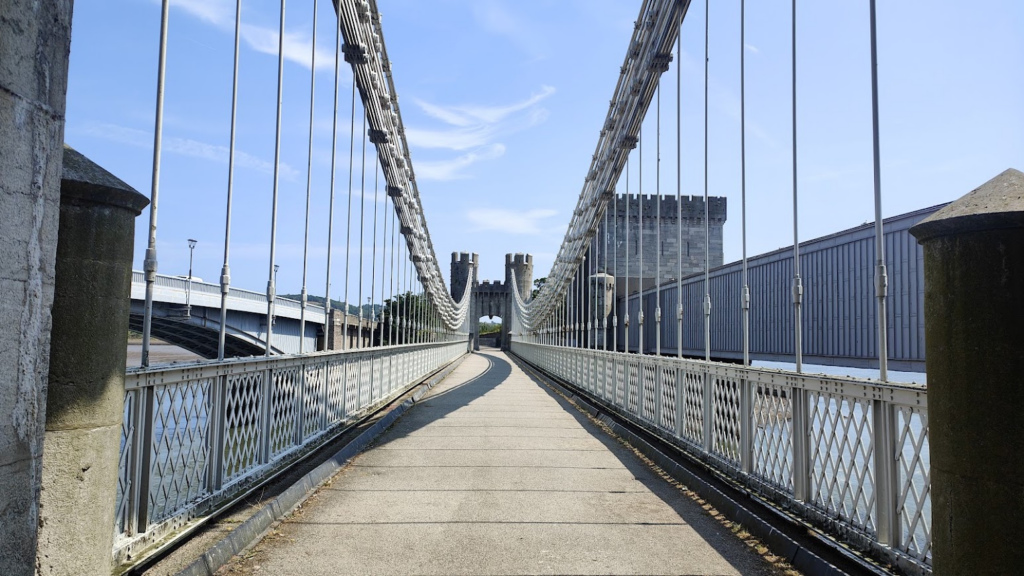
As you face Edward II’s castle, the enclosed railway bridge is to its left and the more modern road bridge to its right, with fine views out to the estuary. The two older bridges are castellated to be in keeping with the castle, whose vertical grey stone walls they more or less run right up against at the town end. The older bridge is decorated in a similar style to the castle, with round turrets; but oddly, the tubular railway bridge has at each end a very rectangular castle tower, not at all the same as any of the nearby ancient castle’s embellishments. I don’t know how the planners allowed that one through. Today, most traffic passes underneath the estuary in a tunnel that carries the A55 well away from the narrow streets of Conwy town.
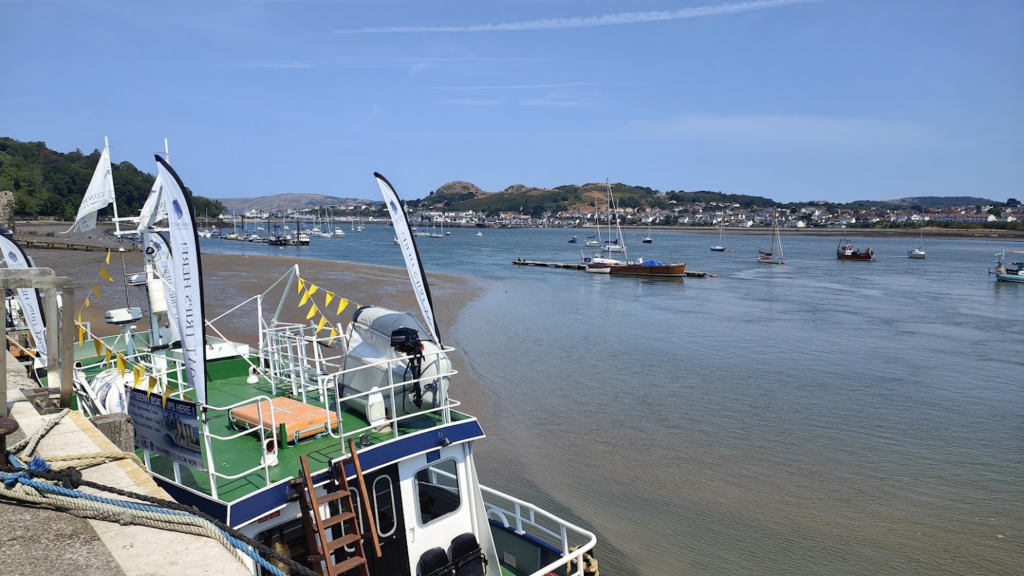
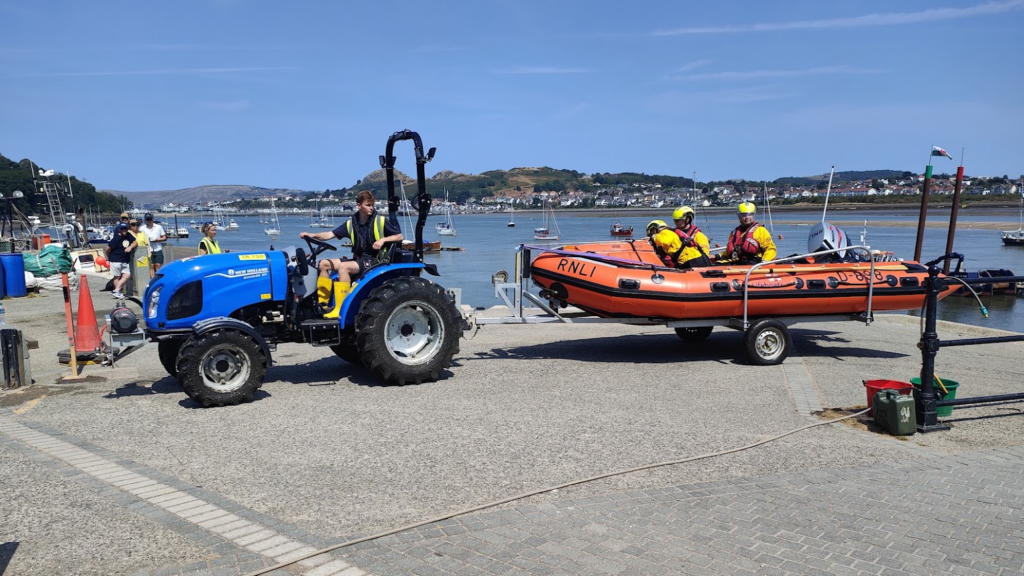
Conwy was busy with all kinds of visitors in today’s warm sunshine, many from overseas. I stopped on the harbourside, bought fresh crab sandwiches for lunch, and watched the RNLI practicing their manouevres. Then I locked up my bike and walked over Telford’s bridge and back. In all the many years of coming here and passing this spot, I had never done this before! It is well worth the trouble.
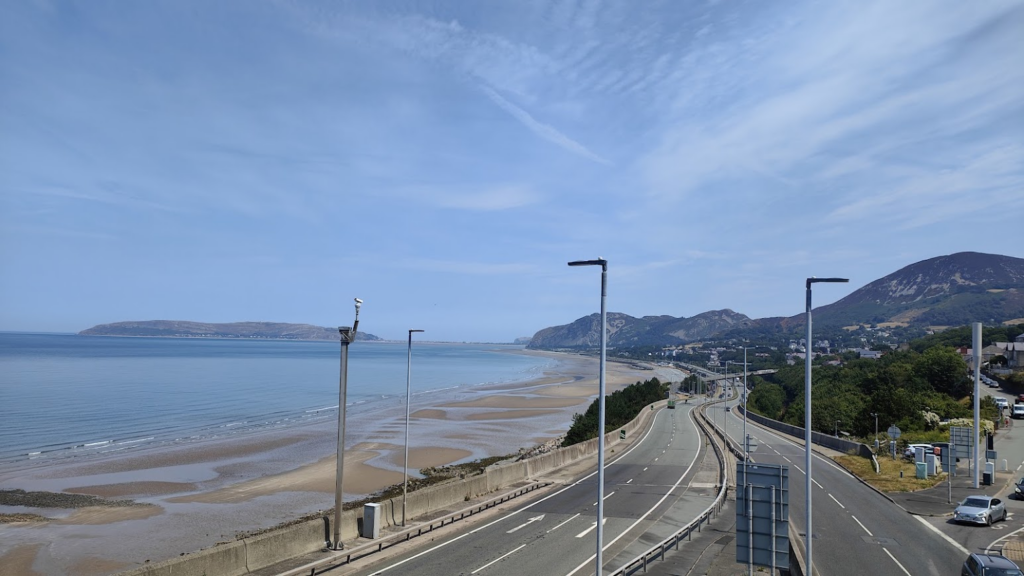
Reluctantly, I left behind Conwy, its castle and its intact town walls and mediaeval archways. The coastal cycle route made its way around the estuary to the newer marina, and then out along the narrow gap between Conwy Mountain and the sea. Through this thin strip of flat land the engineers had to fit the main A55 coastal expressway, and the railway linking the rest of Britain to Holyhead and Dublin. It is a tight fit in places, and a few miles further on it requires a couple of tunnels through rocky headlands, either side of the small quarrying and seaside town of Penmaenmawr. There is a small promenade here, and I took advantage of a seaside café to rehydrate and watch the world go by. The rock faces of the quarry rise up behind the buildings almost vertically. High above, on the cliffs, is a large clock face with a 12 foot diameter face, erected in the 1930s to keep the quarry men on time for their shifts.
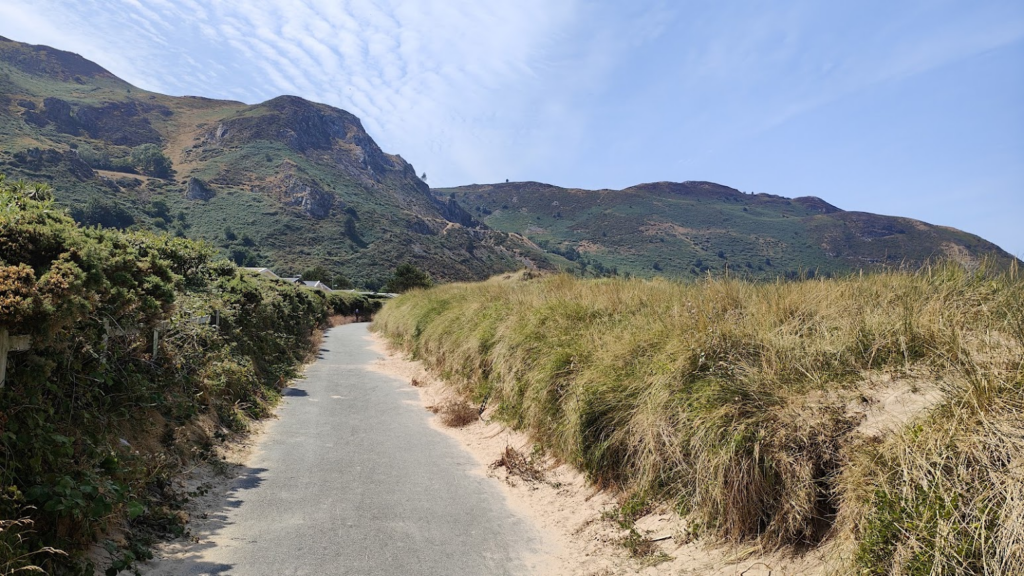
The cycle path can’t pass through the road tunnels, so it has to go up and over them in a complicated system of zig zag pathways. It is quite an exciting route that keeps you on your toes. There are big views out to the north, across the waves to Puffin Island and Anglesey, and looking back to the east, towards the eminences of the Great and Little Ormes, with low-lying Llandudno in between. It all looked lovely today.
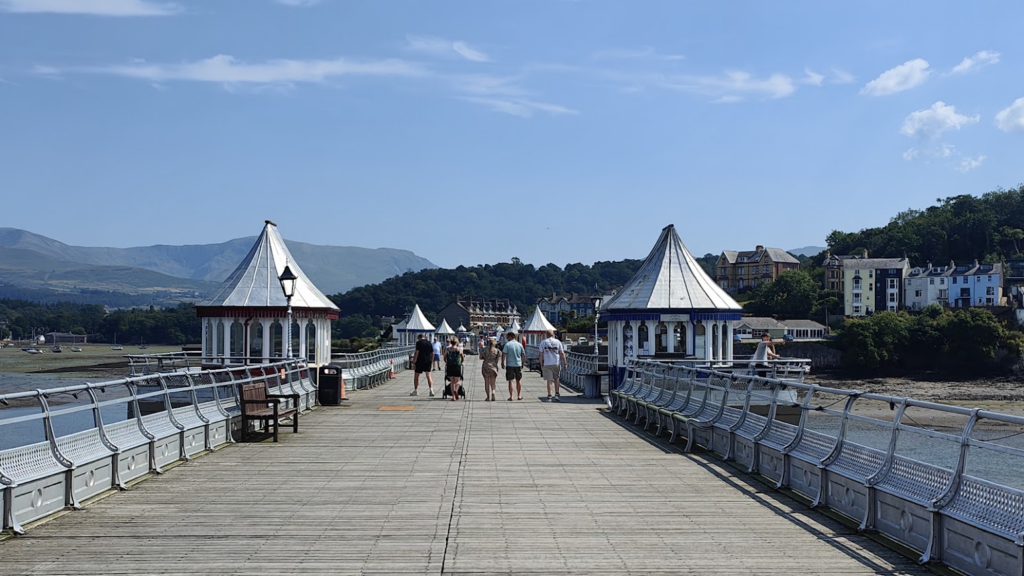
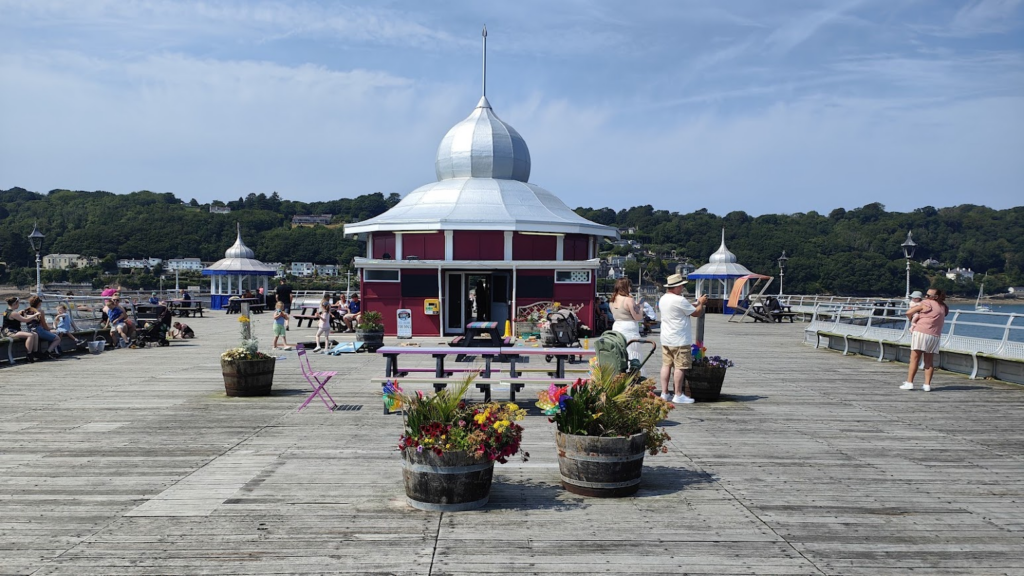
The final stretch in to Bangor followed very quiet, cycle-friendly sections of road that ran close to the main dual carriageway, and I was coasting down a hill into Bangor itself before I knew it. I had plenty of time still to wait, so I headed for one of my favourite places in the area: Bangor Pier. This is a lesser known Victorian gem that I would have been sad to miss. The long and ornate piece of decorated ironwork and wooden planking protrudes from the lower part of town out into the beautiful Menai Strait, across the gap between the North Wales mainland and the island of Anglesey. It reaches about half way to the other side, making for a long stroll to the end – a privilege that cost me a whole pound! At the far end is a welcome café housed in the largest of several bandstand-like pavilions, with Aladdin-like pointed silver onion dome roofs. It was the perfect place for food before my train journey home, and I ate outside. It was a colourful place with flower-filled wooden barrels, brightly painted picnic tables, and small plastic windmills all adding to the cheery scene. The views of the strait were superb, looking east over towards Beaumaris, and west towards Menai Bridge. The tides here are notoriously tricky but small speedboats skimmed across the water in the sunshine. It was all rather glorious.
I turned back towards the Welsh mountains which formed a dramatic backdrop, and then cycled uphill through the large and impressively proportioned buildings of Bangor University, until I reached the train station above. There were other cyclists waiting on the platform, which always causes me a degree of anxiety. I had a bike space booked; but it soon became obvious that I was the exception. There were four Dutch cyclists trying to get to London to catch the Eurostar home, and only two of them were able to get onto the first train to pass through: a London-bound train from Holyhead. The remaining two young women and their bikes got on the next train – bound for Chester – with me, to find there was already another cyclist on board. Noone seemed to mind that we took over one end of the carriage, and I learned that the Dutch group had just completed cycling all the way up the Welsh coast from Swansea. They said they had really enjoyed it, and were impressed by the cycling infrastructure, which I found pleasantly surprising, given the world-class provision they must be used to at home. They also commented on how clear the coastal waters were everywhere compared to the Dutch coast. They had a very tight connection to make at Chester for a London-bound train and I suspect they would have failed to make it; but everyone seemed to be trying their best to help and they didn’t seem overly concerned about finding their friends again. They were especially pleased when I gave them some of cousin Anne’s flapjack from yesterday!
The solo Irish cyclist, from Dublin, was on his way to Conwy to start an endurance cycling race. It was called the Pan Celtic Challenge, and started the following morning. Riders – who are all electronically chipped but would largely be riding alone – can choose from 3 course lengths. Those on the long route were expected to finish in a nominal ten days’ time, although everyone would ride at their own speed. Most of the race is in Ireland – north and south – and the longest course is listed on their website as 1,426 miles, with much climbing also involved. He said he had never tried anything quite this extreme before; but was looking forward to it: cycling between 200 and 300 km most days, and grabbing a few hours of sleep here and there in hedges and fields wherever he could, with perhaps the odd night in a hostel when he needed to shower!
I’m no stranger to long distance cycling and I have covered a hundred plus miles across several consecutive days, especially in 2023 across the great plains in the American West. But this is on another level and seems to me quite mad. I have also – on three separate occasions – cycled 200 miles in a day, and I am sure I would not wish to repeat the feat the next day! It all served to remind me that whatever I set out to do in my own silly cycling adventures, there were always people who were doing much bigger, tougher things, and without any of the little comforts that I prefer to include. I guess we all have our own definition of “fun”. I wished him well as he got off the train in the shadow of Conwy Castle, a place he said he knew nothing about. There wouldn’t be too much opportunity for sightseeing; but at least the weather was set to be warm and fair for the foreseeable future – a useful thing if you are going to be sleeping rough! Rather him than me. I had an important football match to watch with friends, beer to consume, and my own comfortable bed waiting at the end of this train journey!