The oppressively hot weather showed no sign of abating. However, closer to the coast it was a more manageable temperature and there was a helpful cooling breeze. I felt I was in about the best place I could be for today’s exertions, and I wasn’t in a hurry.
Today, I would reach my second UK extremity: Ness Point, Lowestoft. It also happens to be the most easterly point on the British mainland. Two for the price of one. That would come this afternoon; but first I was looking forward to a ride through the quiet, sandy lanes of Suffolk to the coast at Walberswick, on the south bank of the River Blyth, where it reaches the sea. In the hour or so it took me to get there, I saw very little traffic. I passed through a few pretty little villages, most notably Middleton, which contained the perfect ingredients of a large village green, thatched pub, red phone box, and quaint cottages. A handsome church stood behind, with a slender spire rising high from the top of its tower, and a large, friendly blue clock face. It was just as a rural English village should be.
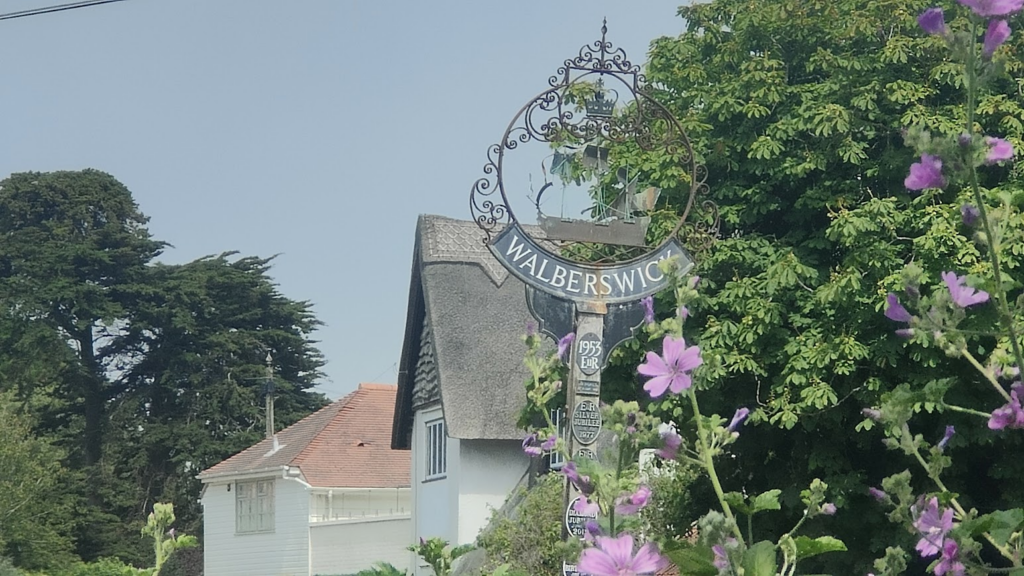
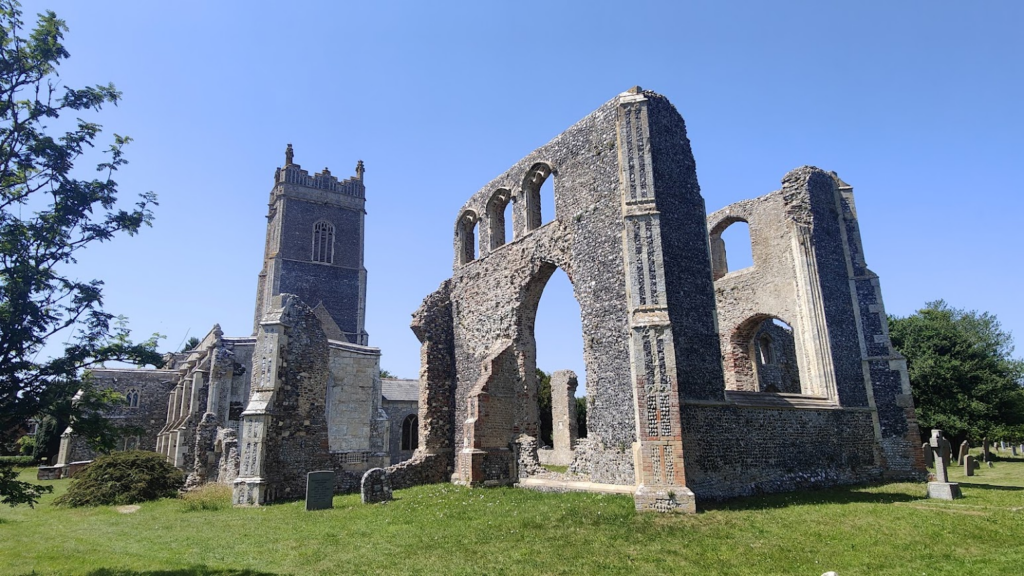
A few gentle miles later, I arrived at the coast. Walberswick is a popular little place, with a range of options for refreshment. The road ends here; but there is a small rowing boat ferry across to the larger resort town of Southwold, which lies on slightly higher ground to the north, within sight. Walberswick is the sort of place that attracts artists, and it is a pleasant place to be, with the presence of boats and water adding to an already impressive village scene. The church was once very large; but over the years much of it was abandoned, leaving the now much smaller building surrounded by ruined walls and arches of flint stone. I nosed around and then went to find a suitable lunch venue, outdoors in the shade.
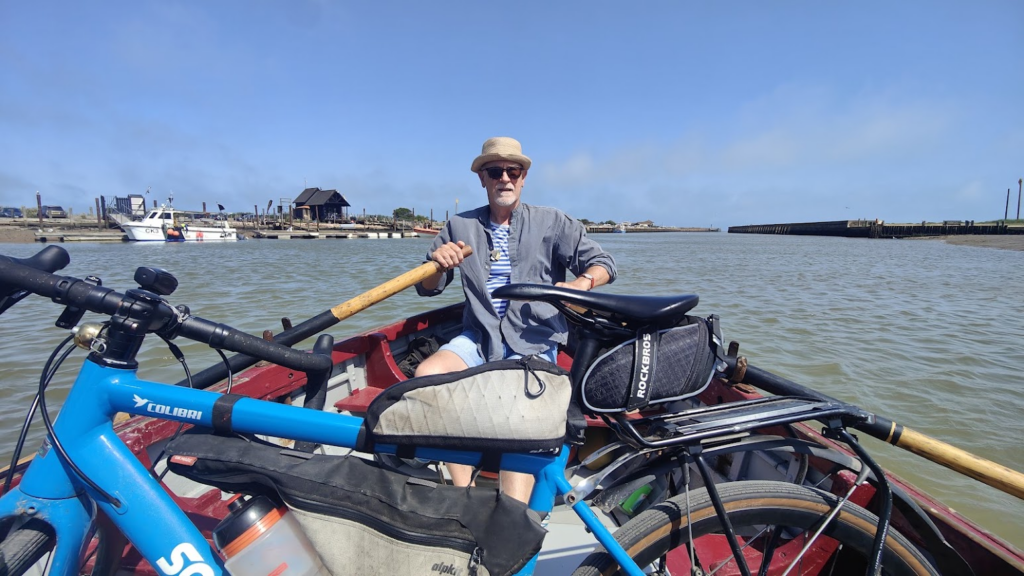
Duly refreshed, it was time to ride the day’s first ferry. You don’t often get your bike rowed over a river – even a small one like this – and the novelty factor was high. There is a footbridge less than a mile upstream; but this felt necessary. It was all over in a few minutes of gentle fun. A polite man in shades and a rather dapper straw sun hat rowed a small group of us quietly between the shingle banks. These moments provide regular highlights in my trips across this country. They are wonderful, curious idiosyncrasies and long may they exist.
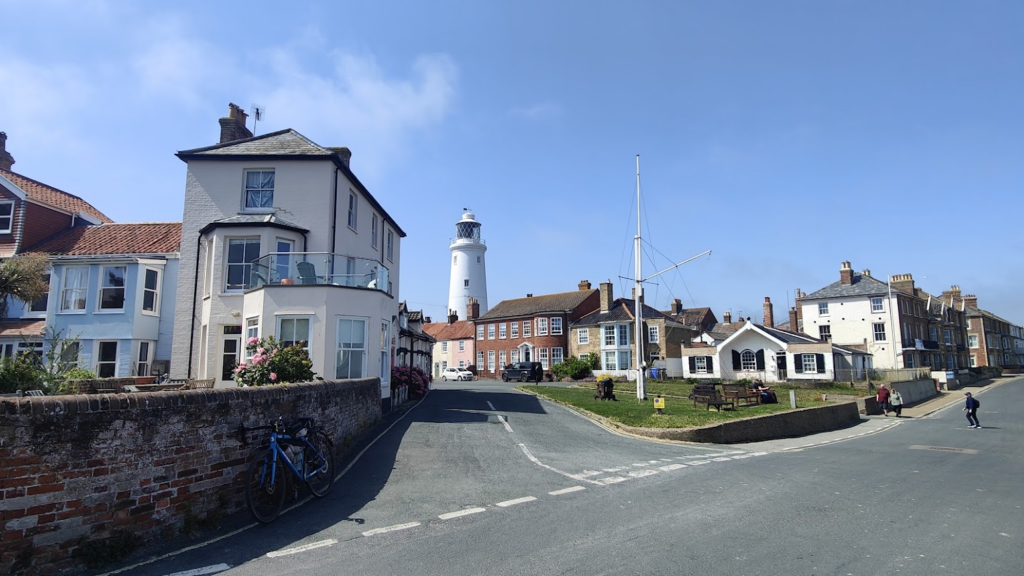
Southwold was much as I remembered it when I last visited in 1997, almost 30 years ago. Now, as then, it felt like a charming film set from the 1950s, when the world was a simpler place. I liked it all the more for that. It is a maze of narrow streets and old-fashioned brick buildings with small, independent businesses and the large Adnams brewery, whose beer is sold in every one of the town’s many quaint pubs. There are long rows of colourful beach huts lining the sea front above a sandy beach, a short pier, putting greens and a model boating lake (annual host of a model yacht regatta). Back from the sea-front, a white lighthouse sits in the centre of town, a couple of streets inland from (and safely above) the sea. Today in the warm sun, the place was bustling. I would happily have stayed; but I still had business further east, just up the coast.
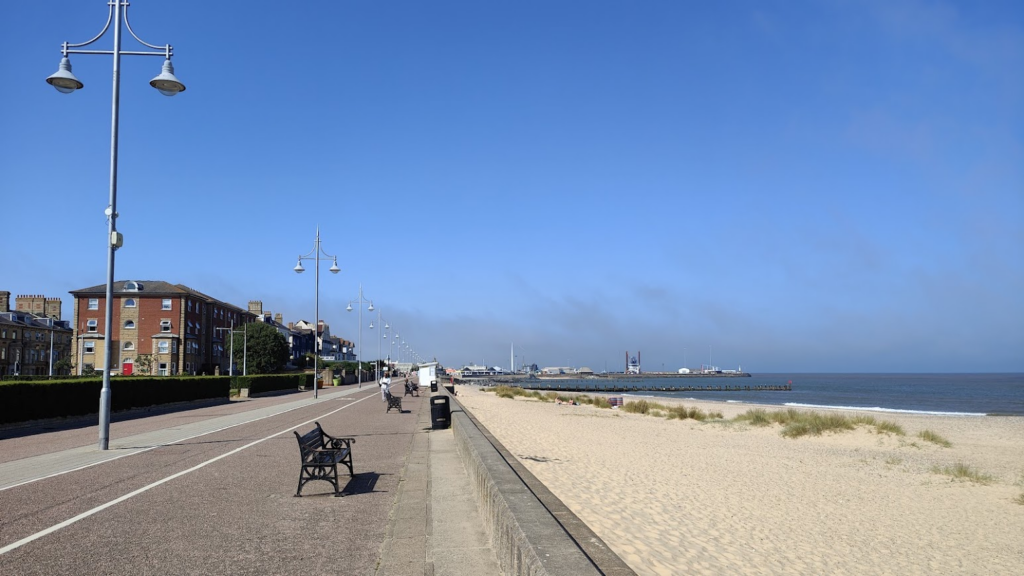
To get to Lowestoft, the utter east, I had first to head back inland, avoiding the busy A12. After perhaps an hour of the quietest lanes, the southern portions of Lowestoft, a large port town, began to appear. At first, it seemed quite a well turned-out place, with a proper seaside feel and some attractive Victorian houses lining the promenade. If I was to judge the town on its South Beach and the area round the Claremont Pier, I might be inclined to think rather differently of it overall; but that would only tell half of the story. The most easterly point lay over a swing bridge across the Inner Harbour, and out beyond the docks. This part of town had an altogether different appearance. It was industrial and made no attempt to look pretty. A single, large wind turbine presided over the scene.
My cardinal destination, Ness Point, was at the end of a rather windswept road (called Gas Works Road) that led me behind a large seafood factory. When I arrived on the concrete promenade area, I was confronted by a large, circular, metallic compass laid into the floor. The waves were breaking nearby over the sea wall. I was the only one around to enjoy the wonders of the ground marker, which told me the distance to places in just about every imaginable direction. London, from where I had recently come, is 106 miles as the crow flies. Dublin, where I would now be heading, is 340 miles away. Lizard Point, the southern cardinal point of mainland Britain – close to where my trip had begun – was now 352 miles distant. Dunnet Head, in Caithness, mainland Britain’s northern cardinal point, is 472 miles from Lowestoft in a straight line running roughly NNW. I hoped to be there sometime in August, but I would not be following a straight line to get there – far from it. My next extremity on the British mainland would be Ardnamurchan Point, 451 miles away in a direct line, and many miles more if – like me – you were also collecting the UK extremities along the way. That quest would take me next to Northern Ireland. There was no mention of these extremities, even though Ness Point is one of them.
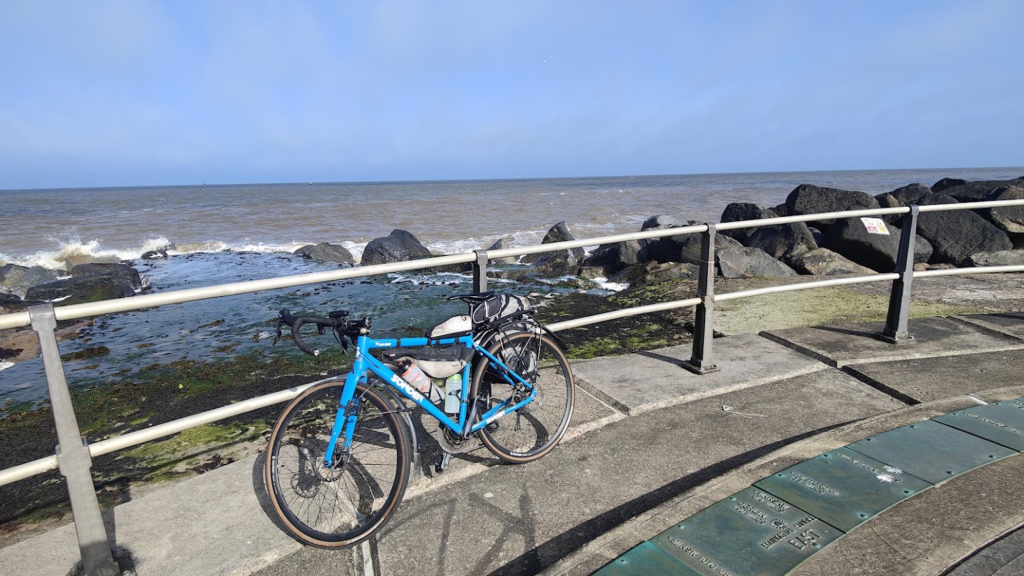
Due east of here, of course, is the North Sea. There is no more land. But if you kept going then after 490 miles you would reach Berlin, and on almost the same trajectory Warsaw was 814 miles distant. Amsterdam is just 133 miles away, and also in a roughly easterly direction are Minsk at 1070 miles, and Kyiv at 1244 miles. I reflected that I still had something of that order of mileage ahead of me before I finally reached the top of Shetland!
It was time to leave, so I took my photos and headed quickly away from these slightly post-apocalyptic surroundings, and north-east through suburbs towards the Norfolk Broads. This flat, watery world now stood between me and my overnight stop in the city of Norwich.
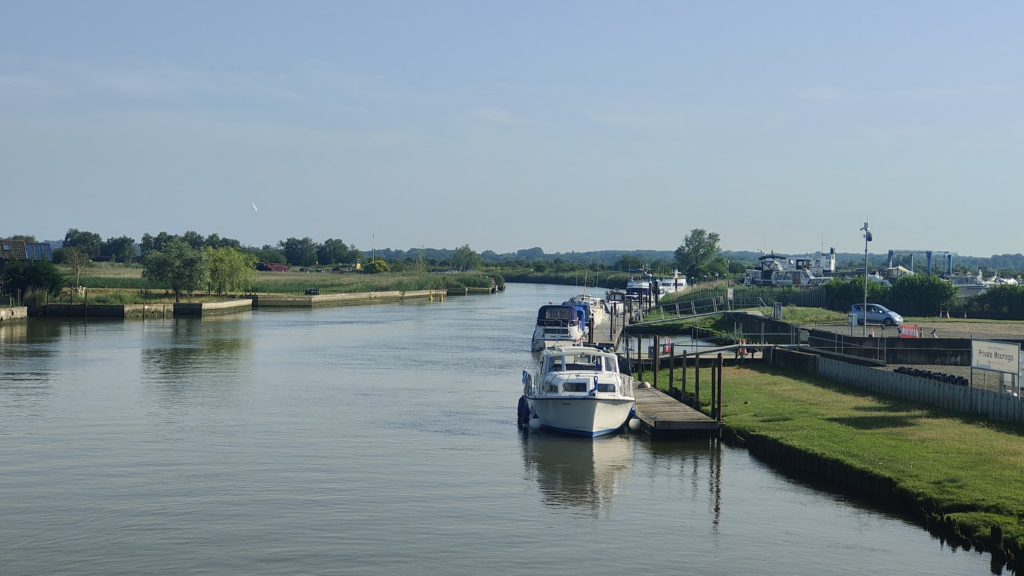
The watery nature of the Broads makes route options quite limited, especially if trying to avoid main roads. Bridging points over the rivers and interlinking channels are relatively few, and I was stuck with only one sensible way forward until I was over the River Waveney at St Olaves. All around here are an abundance of boatyards for pleasure craft, and you often see colourful sails rising up over the flat fields.
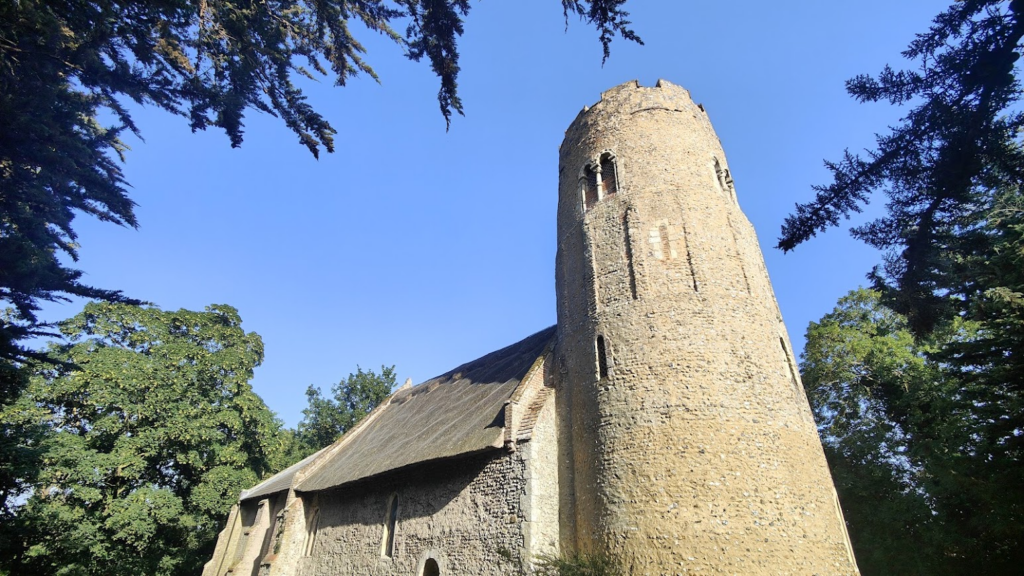
After the bridge, tiny lanes took over again, taking me past ancient thatched, round-towered churches that often had no obvious village to support, barring the odd farm. It was early evening now, and the temperature was getting more pleasant. I had in mind a place for an outdoor pub dinner by the next major river crossing, when I reached the River Yare at Reedham. I knew about this pub because behind it is a camp site where we have pitched our tent in years gone by, before we had children (now more than 25 years ago!), including a rare moment when we actually got my parents-in-law under canvas.
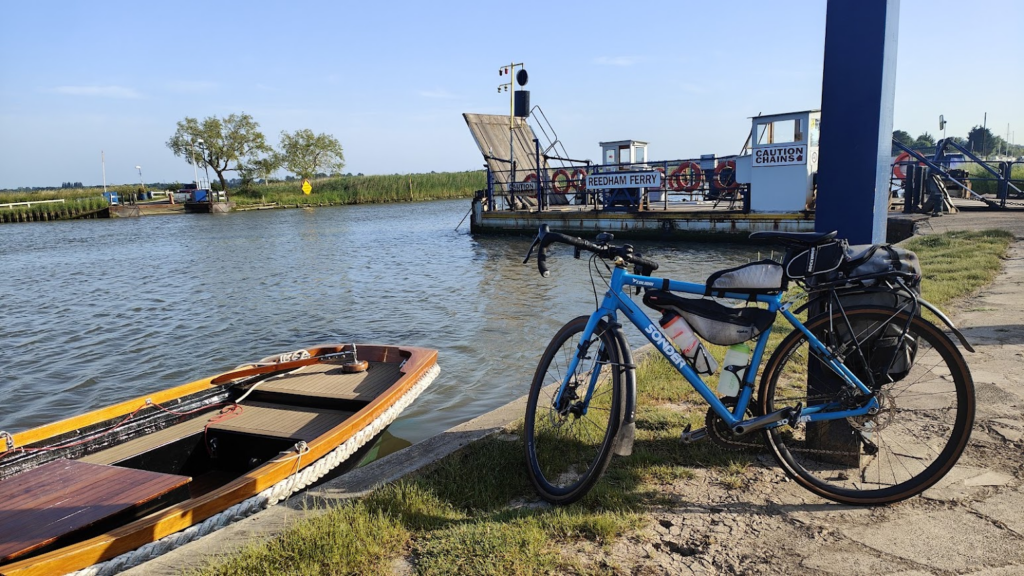
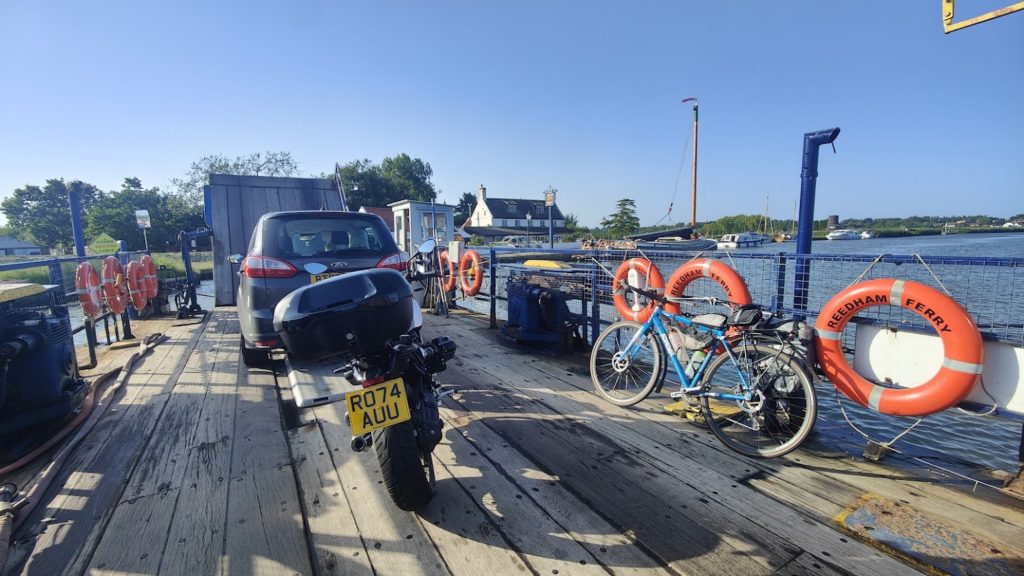
But before the pub, another treat lay in store: the Reedham chain ferry. This delightful relic rattles back and forth across the river on a quiet country lane, carrying a maximum load of two cars, and operated by a single ferryman. It cost me a pound to cross with a bicycle, and while I watched on with my pint, a whole peloton of local evening cyclists all made use of it en masse. Otherwise, just the occasional car or van broke the ferryman’s interest in a tall-masted wherry that was moored up alongside the pub. It was a lovely spot to enjoy a hearty meal in the sunshine, leaving me free to enjoy the final hour or so of my journey from Norwich without time pressure or concern about finding food.
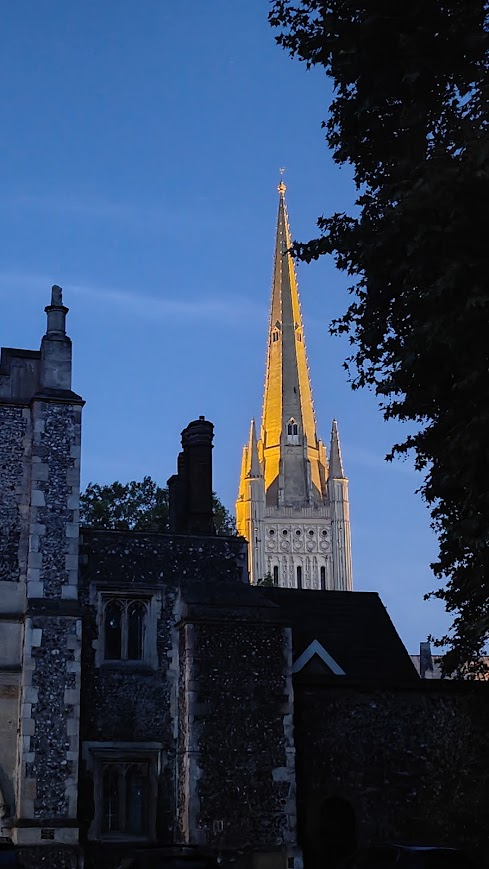
The last part was quiet lanes and rural villages until the final couple of miles into the city centre. I like Norwich. It is very much a regional capital; but it is quite a small city. And a very historic one at that. Norwich possesses one of England’s finest mediaeval cathedrals, with its second tallest spire after Salisbury, all set among fine Georgian homes and other ancient collegiate buildings in the walled cathedral close. The rest of the city is of a broadly similar age and quality, with a fine Norman castle keep, narrow winding streets, a large open market place, and more mediaeval churches (mostly built of the local flint) than any other city north of the Alps, or so it is said. They certainly seem to be more or less everywhere you look, although the majority are no longer used as places of worship in these heathen times. All of this history is enclosed by a loop of the River Wensum, in which you can while away a happy hour or two gently paddling around in a canoe. So there is plenty to like and I’m always happy to pass through.
I went for a wander around in the late evening, and holed up in a quiet city centre pub, where I happily chatted to the otherwise bored young woman man behind the bar, and sank a couple of pleasing pints of Adnams Broadside, brewed in Southwold, where I was just this afternoon. It already seemed a very long time ago in what had been another excellent summer’s day of cycling.