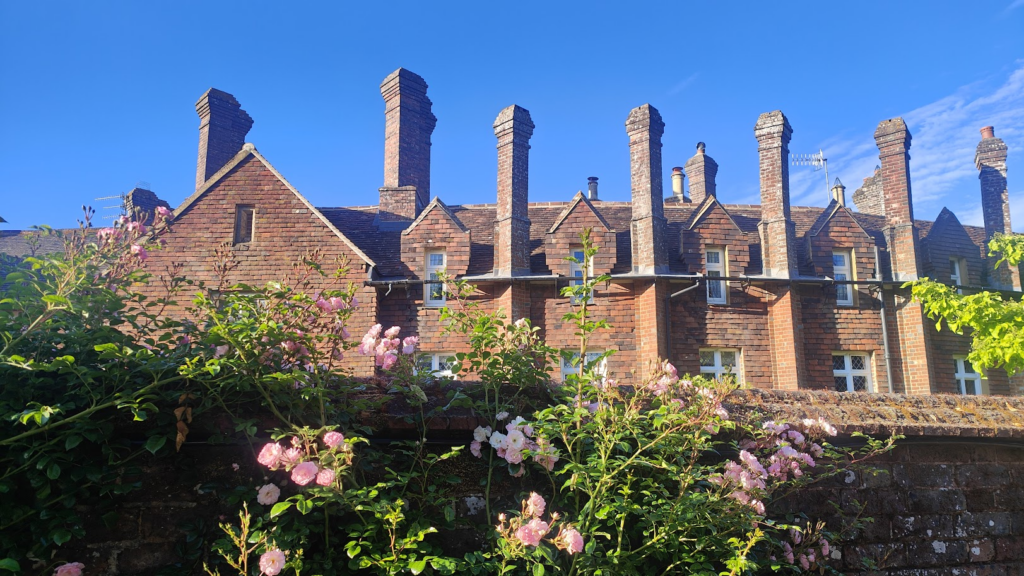
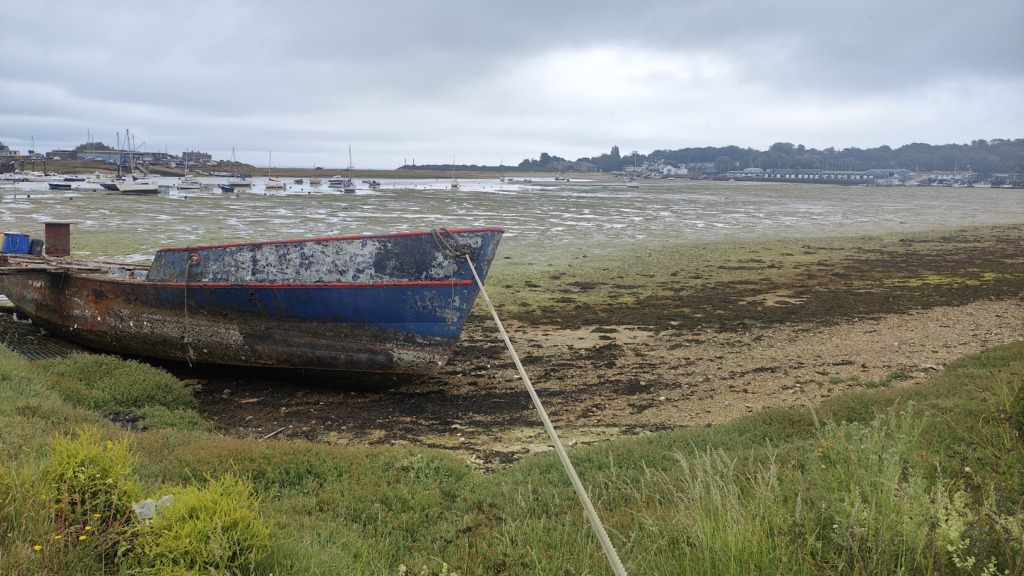
Hovercraft and ferries wait for no man; but sometimes the adventure cyclist has to wait for them. Today was always going to be a long day; but when I saw a hovercraft leaving Ryde beach for Portsmouth a few minutes before I arrived at the check-in building, I knew there would be consequences. But, like yesterday, I had at my mercy one of the longest days of the year – and nothing in particular to do at the end of it. So there was perhaps an inevitability to how things unfolded.
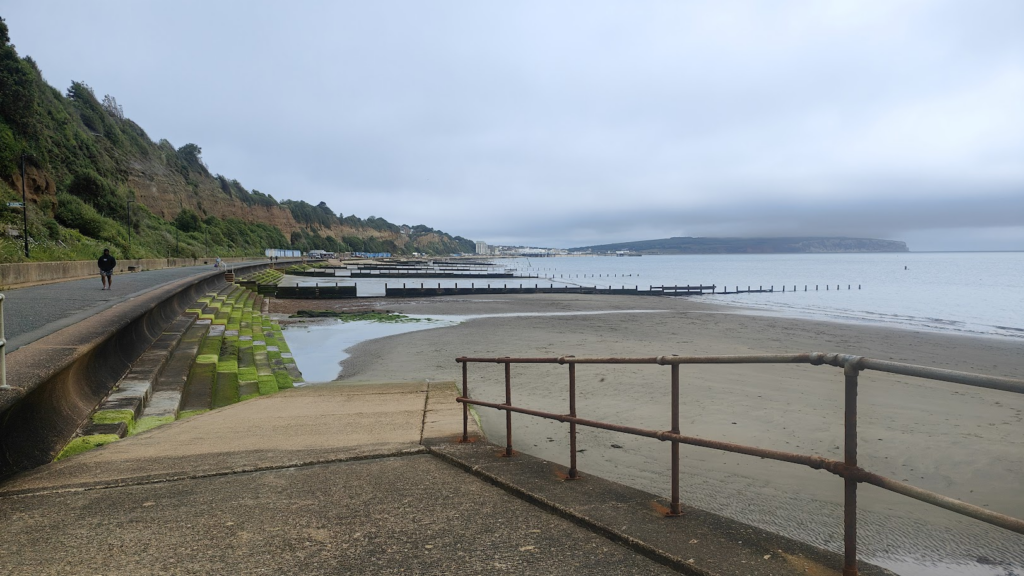
It all began with a ride along the promenade from Shanklin into Sandown: two traditional seaside holiday towns together occupying a sweep of coastline between chalk cliffs at either end of the bay. They each gave the appearance of trying to cling on to some of their former grandeur, while also showing signs of the economic struggles of modern life. But there were plenty of people out having a late breakfast in the seafront cafes, and I joined them next to Sandown pier. It was a cheerful scene as the sun finally won the battle with the morning sea mist.
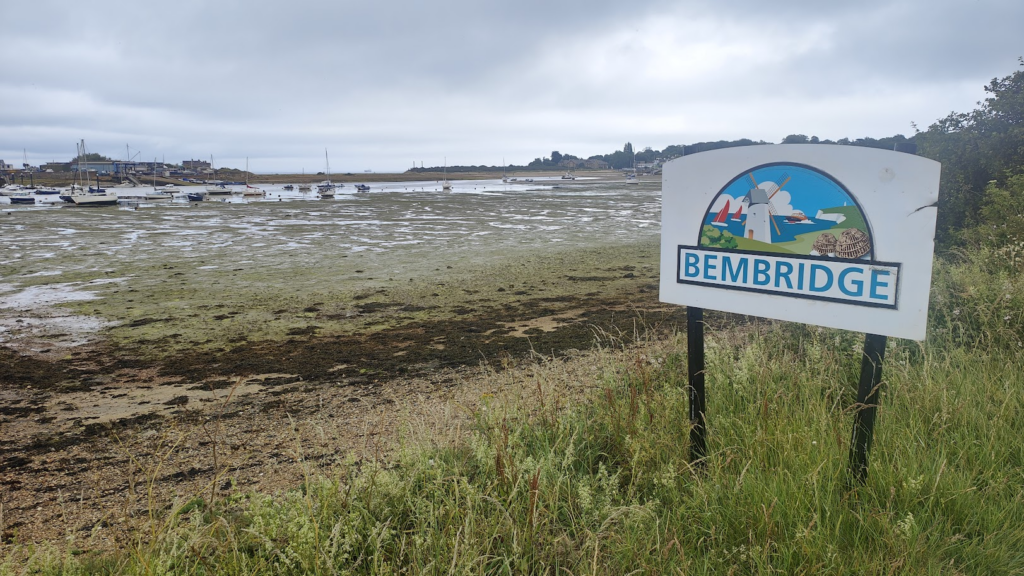
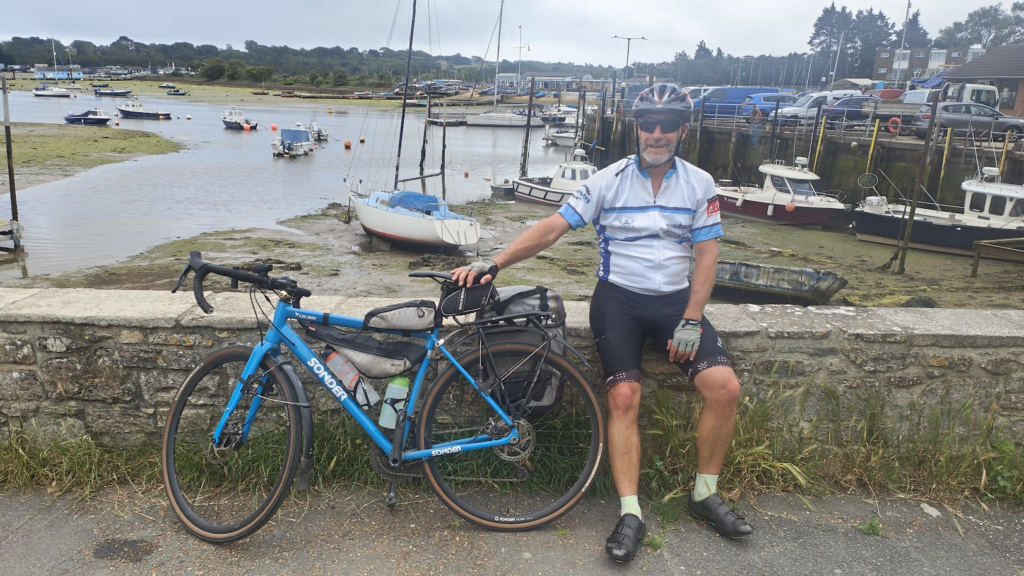
Duly refuelled, I pushed north-east along the coast and made my first ascent of the day up Culver Down, dropping back down the other side into leafy, well-heeled Bembridge, which sits at the eastern most tip of the Isle of Wight. This is as extreme as this visit to the island would get for me. In a straight-ish W-E line it is about 21 miles from Yarmouth, where I made my landing last night. The island is much wider than it is deep, so to speak, but it is all a very manageable size. The famous Needles chalk sea stacks, which lie at the very western extremity, are just 5 miles SW of Yarmouth. But, like many islands, it manages to contain quite a variety of places and landscapes, and I particularly like the NE corner where I now found myself. It is a world of watery inlets and many boats, docks and boatyards. The villages are prim and proper, with narrow winding lanes and handsome houses. It has a genteel air of understated prosperity, and you feel life here must be comfortable for those lucky enough to call it home.
Turning the corner, I cycled along through parks and gardens to emerge on the faded grandeur of Ryde seafront, facing north across the Solent to Portsmouth, which was clearly visible in the sunshine. And that is when I saw the hovercraft speeding off across the waves.
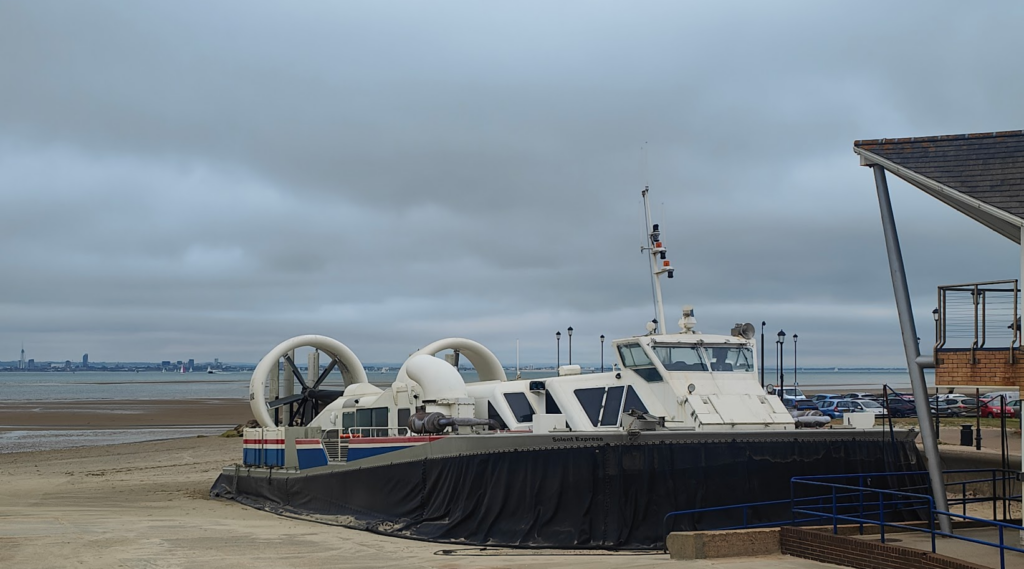
The Ryde to Southsea passenger hovercraft service is the only year-round scheduled service in the world, which I find an amazing fact. So, despite a passenger ferry option from the end of Ryde pier (which excitingly has a train running right to the end of it!), I was in no doubt that it would have to be the hovercraft for me today. And that now meant a wait of about 50 minutes. In these circumstances, with the morning largely gone and almost 70 miles of cycling still ahead of me, I did the only sensible thing: I went for tea and cake at the Royal Esplanade Hotel!
The hovercraft crossing – or “flight” – is actually pretty uneventful, if a little strange. It inflates in seconds and simply drives off the beach and onto the sea! The ride was smooth and in half an hour we had driven back onto the beach in Southsea, deflated, and all got out. Simple as that. It’s arguably not as much fun as a ferry, which rarely disappoints; but for novelty value really couldn’t be overlooked. Besides there would be more ferries on this journey – many more – including one very shortly.
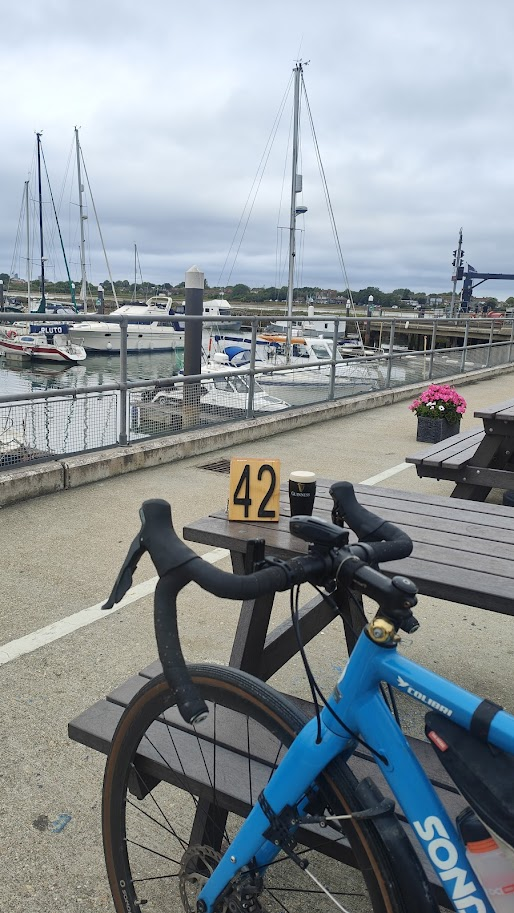
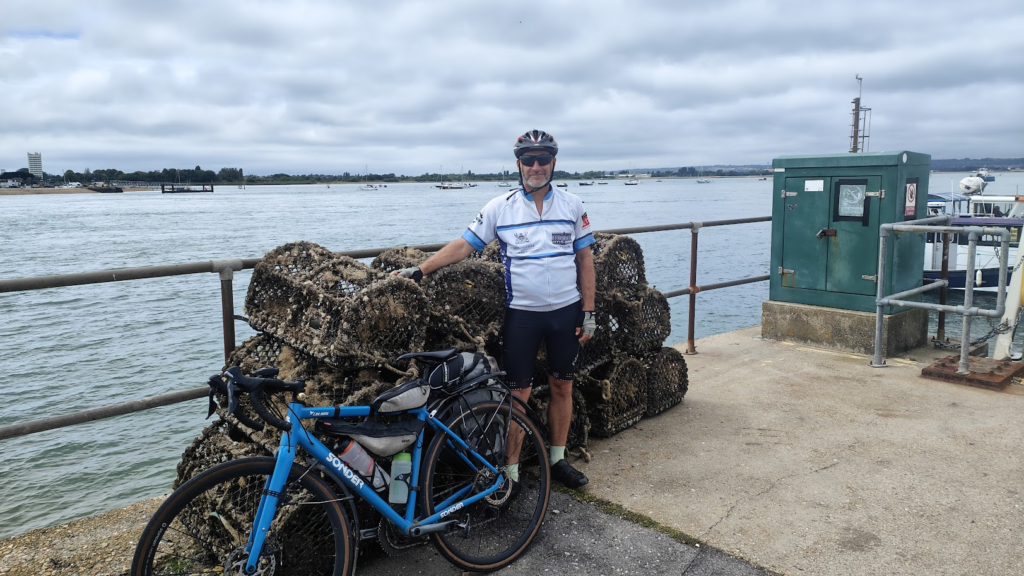
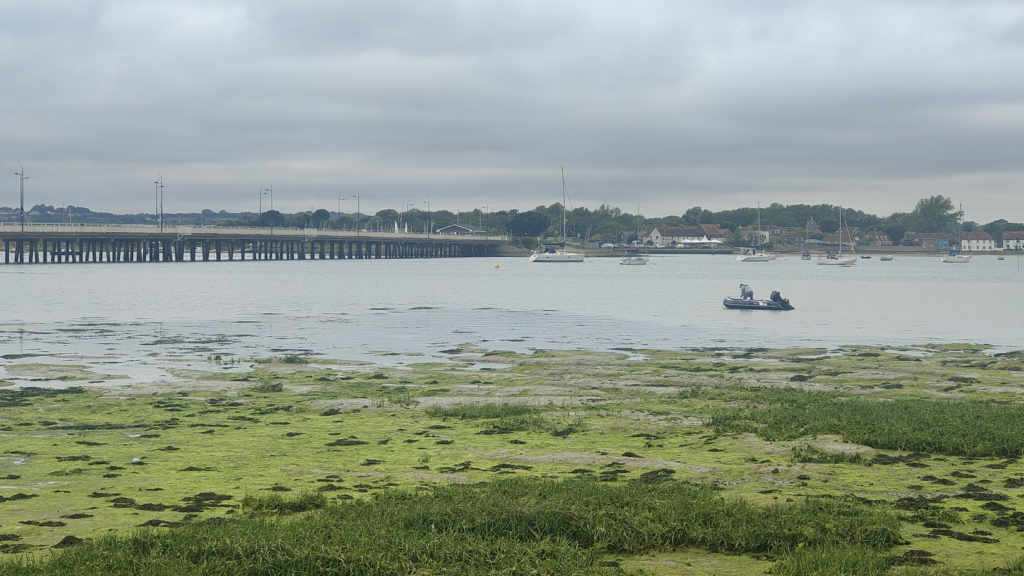
I turned right and cycled along several miles of sea front in Southsea, taking me away from Portsmouth proper, and its shining white Spinnaker Tower, a striking Millennium project landmark. There are large parks and lawns all along this stretch of coast, and a promenade, and it was thronging with people and public events this sunny summer Saturday. I was technically on another island: Portsea Island, although modern bridges make it feel more like a peninsula off the south coast of England. Next to it, to the east, lies another: Hayling Island, and the two are connected across the narrowest gap by a small passenger ferry. It is perhaps surprising that these two islands remain so separate and different in nature. Portsmouth is a large and densely populated city whose physical limits are defined by its geography. And yet the small, sandy spits of land – that protrude towards each other from the adjacent islands and don’t quite meet – feel quiet, out of the way places where just a few folk come to fish or sit in deck chairs on the shingle. It’s an odd, forgotten corner. The ferry runs from a landing stage where the small road runs out. I knew the timetable and that my hovercraft would get me to Southsea too late for a smooth connection. But I spotted a handy small marina, facing inland between the islands, on the sheltered waters of Mulberry Harbour, and it had a pub. And it was open! And that meant lunch. An impressively quick one, admittedly; but every minute counted today, and it was excellent use of time. I had to eat – may as well do it now, next to the clinking masts, close to the ferry. The pub duly obliged.
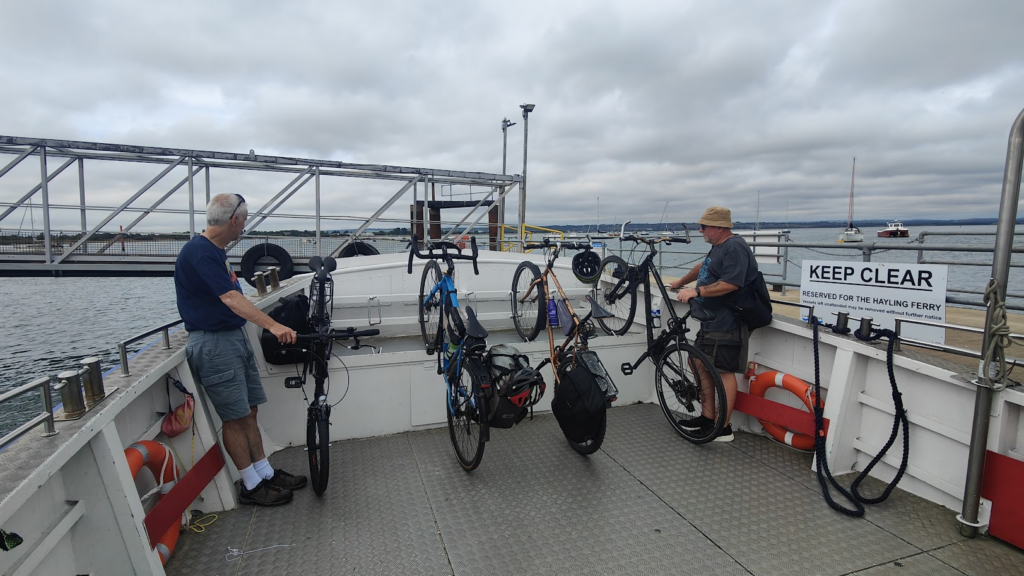
The Hayling Island ferry was a small boat, but unusually in my vast ferry experience it was fitted out specifically for the easy carriage of several bicycles in a purpose fitted bike rack. I think most of the handful of passengers today had two wheels, and it makes a lot of sense. The alternative route between Hayling Island and Portsmouth would be many miles longer and very much busier. There was another handily placed pub for those waiting in Hayling Island, and then a few more miles of quiet dunes before I arrived in Haying Island town, which is a small seaside resort. My highlight here was seeing a miniature railway train chug past along the promenade; but otherwise it could have been so many similar places. Except that only one road – the one to the bridge across to Havant – actually leads anywhere. I would have liked to continue hopping across from one landmass to the next; but there is no ferry across Chichester Harbour to Selsey Bill (another tempting minor extremity), so it was clearly time to strike off inland.
There is a quiet route through small villages to Hayling Island bridge, which was a relief because the single main road was busy and not very wide. Ahead of me reared the hills of the South Downs. They would have to be crossed somewhere. I needed to get to Lowestoft for the UK’s most easterly extremity, and that meant getting over the Thames somehow. Realistically that meant London, which is actually quite far inland; but there are no ferries or bridging points after the M25 Dartford crossing, and I didn’t fancy that. I also knew that London always delivers exciting cycling experiences and – well, it’s London, one of the world’s most incredible cities. Plus I had the offer of accommodation there. So, for now, it was a question of how to join the dots between here and there. That wasn’t as easy as you’d think, because most of the routes crossing the South Downs are main roads, and I try to avoid them. But on the other side of Havant, where I now found myself, a succession of lanes and B roads could be joined together making a route that promised much more enjoyable cycling, all the way, it seemed, to Reigate. I’d found a cheap place to stay there, too. So the challenge was set.
Despite my many travels, I don’t know this part of the world. It would be a journey of discovery – like so many are. You never run out of things to see. That is one of the brilliant things about this country. Around every corner lies a new surprise. The town of Havant was a minor inconvenience that I had to get past first. It was a reminder of what I am generally trying to avoid. Retail parks, queuing traffic, housing estates, and everything that goes with it. You can keep all that. I find I am increasingly turned off by it all. But just beyond, as I started to climb, I passed a sign welcoming me to the South Downs National Park, and everything changed again.
To be honest, the rest of the day was a continuous delight. I don’t remember any part of it I didn’t enjoy. There was nothing spectacular – this is not a National Park of stunning scenery like, say, the Lake District or the Yorkshire Dales. It is gentler, rolling English countryside: more leafy and green, and studded with attractive and convivial villages with old buildings and fine churches. I liked it very much, and I loved my cycle route. It is occasionally good to congratulate oneself on a job well done. This route suggested itself to me from the familiar features of my Ordnance Survey online Landranger map, zoomed in from a bird’s eye view of the places I needed to connect. You can get quite good at knowing what looks like a promising way to take, but never really know until you try it. Today, it worked out beautifully: both figuratively and literally.
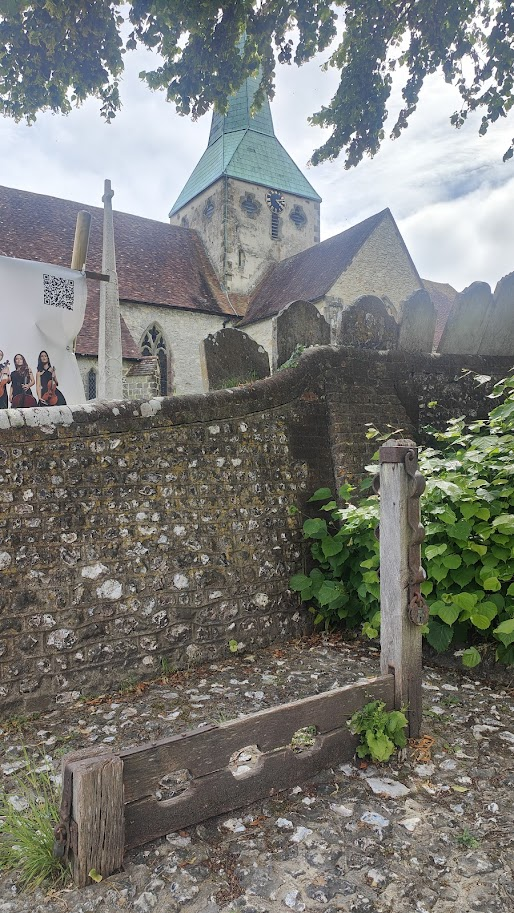
I stopped for photos here and there: first, just beyond pretty Rowlands Castle, the tiny St Hubert’s chapel, “The Little Church in the Field”, on its own on a hillside, where a country wedding had just taken place; and then the old village stocks in lovely South Harting, outside the magnificent cruciform church with its green copper spire. A lady passing by assured me that they are no longer used.
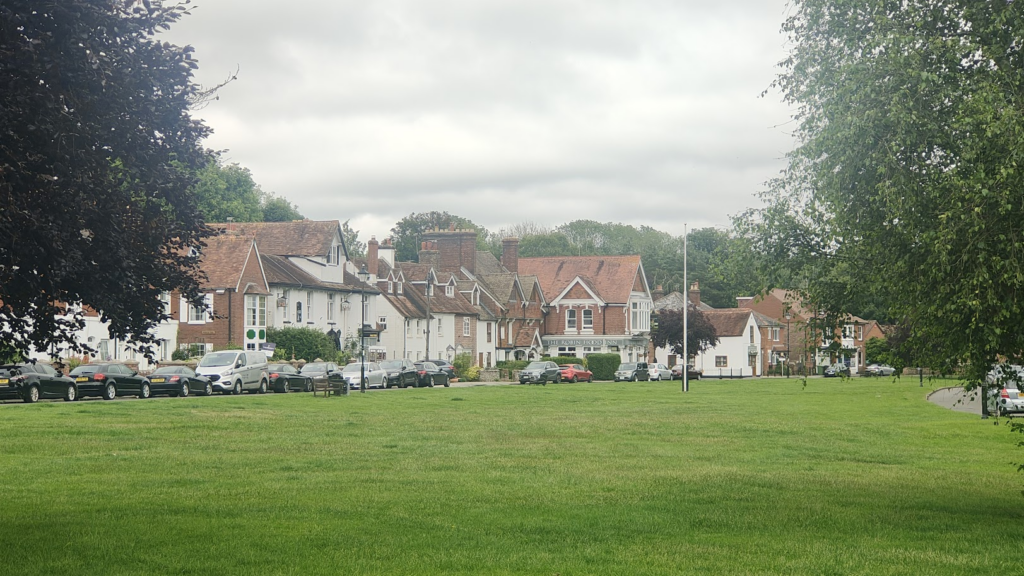
As the day wore on, I began to think about eating opportunities. It took two separate pub stops to fulfil that brief. The first, in the charming village of Dunsfold, was an obvious choice: a quintessentially southern English scene of a pub next to a large green, upon which a game of cricket was being played. The Sun Inn offered many outside tables and an event was taking place in the pub’s garden. Sadly, that meant no food until 7pm and I was too early – imagine that! So I rehydrated and took on salt, and pushed on another hour. Dunsfold, it turns out, is home to the Dunsfold Collection – a museum of all things Land Rover and Range Rover, right next to TV’s famous Top Gear Test Track (an old airfield), with its Hammerhead bend, where stars raced the clock in a “reasonably priced car”. Who knew? I didn’t, despite cycling about as close as you possibly can to the track itself.
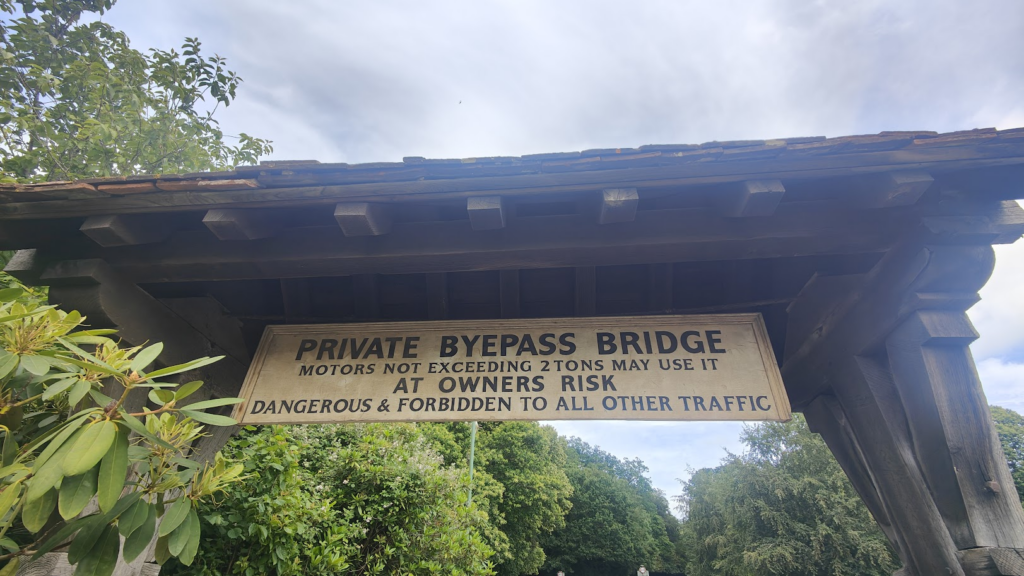
After more miles along more leafy lanes, I happened upon the inviting Punchbowl Inn at Okewood Hill, where a most pleasant fishy outdoor dining experience unfolded. And then, I had a couple of hours of daylight to complete the journey along quiet roads all the way to Reigate, a lovely and, tonight, lively old town of half-timbered buildings. It felt affluent – a rather different place, I imagine, to the one where my mum went to the Girls’ Grammar School as a teenager. Reigate also delivered a couple of rather uncalled-for big hills to test my reserves at the very end of a 99 mile day (if you include the hovercraft, which I most certainly do!). But I made it, ensuring that if nothing else, tomorrow would have a downhill start! This was the longest day of the trip so far, if not the hardest. I had enjoyed it all – and it had included a wide variety of experiences. Tomorrow would be different again – I was going to London!